How Compost Toilets Can Restore the World's Water

There is something deeply telling about the way modern civilization has chosen to manage its waste. We take one of the most nutrient-dense biological materials on earth, mix it with millions of litres of clean drinking water, and flush it into rivers, lakes, and oceans — fouling the very systems we depend on to survive. It is a design so fundamentally backwards that future generations may look back on it the way we look back on lead pipes and open-air surgery: obvious in its error, staggering in its scale.
Compost toilets offer a different path. Simple in principle, profound in consequence, they represent not just an alternative sanitation technology but a reimagining of the relationship between human bodies, living soil, and water. As freshwater scarcity intensifies across the globe and wastewater infrastructure buckles under the weight of growing populations, the humble compost toilet is quietly becoming one of the most radical acts of ecological common sense available to us.
To understand the stakes, consider the numbers. A conventional flush toilet uses between six and thirteen litres of water per flush. In a household of four people flushing five times a day, that amounts to roughly 120 to 260 litres of potable water consumed daily — not to sustain life, but to transport waste. Globally, toilet flushing accounts for approximately 30 percent of indoor residential water use in developed nations. In a world where over two billion people already live in water-stressed conditions, the arithmetic is unconscionable.
But the problem doesn't end at the toilet. That flush initiates a long, energy-intensive journey through sewage treatment infrastructure — infrastructure that, even when functioning optimally, releases partially treated effluent into waterways, contributes to nitrogen and phosphorus loading in freshwater systems, and produces significant greenhouse gas emissions. When it isn't functioning optimally — which is much of the world — raw sewage flows directly into rivers, groundwater, and coastal zones, poisoning drinking sources and collapsing aquatic ecosystems. The UN estimates that over 80 percent of the world's wastewater is discharged without adequate treatment. The flush toilet, in this light, is not merely wasteful. It is actively destructive.
A compost toilet severs this chain entirely. By separating human waste from water at the point of origin, it eliminates the contamination problem before it begins. Urine — which contains the vast majority of the nitrogen and phosphorus in human excreta — is diverted separately and can be diluted and applied directly as a crop fertilizer. Feces, mixed with carbon-rich material like sawdust, wood chips, or dried leaves, undergo thermophilic or mesophilic composting: a biological transformation driven by heat and microbial activity that, over time, renders pathogenic organisms inert and produces a stable, humus-like material safe for use on non-edible plants and, in many advanced systems, on food crops as well.
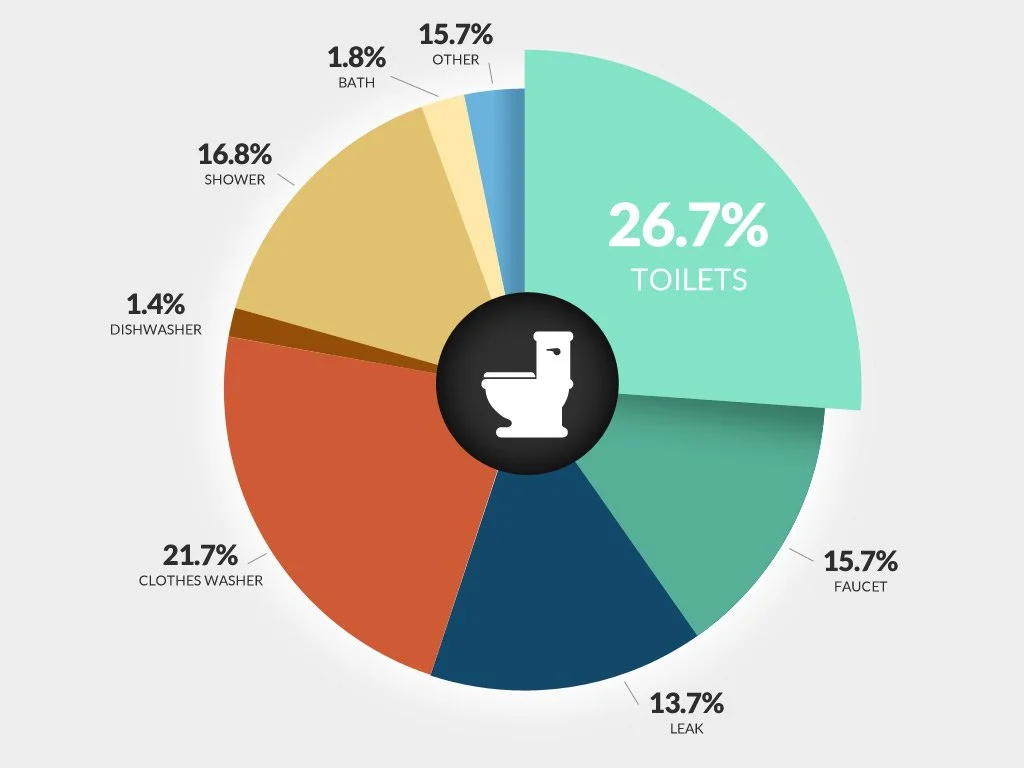
Average (western) household water usage. Water-flushing toilets use the most water.
No water is required. No sewer line. No treatment plant downstream. The waste stream that in conventional systems becomes a water-quality liability is instead converted into a soil-building asset. It is the same logic that has governed Indigenous land management, traditional agriculture, and ecological design for millennia: close the loop, return what was taken, treat nothing as waste.
Composting is a biological process, and like all biological processes, it is governed by temperature. This is where tropical and subtropical climates don't just participate in the composting sanitation story — they accelerate it. In temperate zones, composting systems require careful management of moisture, aeration, and thermal mass to maintain the microbial activity needed for effective pathogen die-off and material transformation. In the tropics, the climate does much of that work for free.
Ambient temperatures across tropical regions — South and Southeast Asia, Central and West Africa, the Amazon basin, the Pacific Islands, and South Asia's river deltas — routinely sustain the 35°C to 55°C range that thermophilic bacteria thrive in. Decomposition that might take twelve to eighteen months in a Nordic country can complete in six to eight weeks in a well-designed tropical system. The abundant biomass available as carbon amendments — coconut husks, banana leaves, sugarcane bagasse, rice straw — further accelerates the process while diverting organic agricultural waste from open burning. Tropical rainfall, managed correctly through ventilation and drainage design, creates exactly the moisture conditions that drive microbial metabolism without waterlogging the pile.
The result is a compounding advantage. Not only do tropical regions tend to lack the sewage infrastructure that wealthier nations take for granted — meaning the need is most acute where solutions are least available — they also offer the biological conditions under which composting sanitation performs at its absolute best. Heat, humidity, organic material: the tropics are, in a meaningful sense, the natural home of this technology.
The benefits of compost toilet systems extend well beyond water savings, and understanding this requires looking at what healthy soil actually does for water. Living, organic-rich topsoil functions as a vast sponge and filtration system. It absorbs rainfall, holds moisture, recharges aquifers, and filters out contaminants before water reaches groundwater reserves. Industrial agriculture — which strips topsoil through tillage, depletes organic matter through synthetic fertilizer dependency, and compacts ground through heavy machinery — has severely degraded this function across hundreds of millions of hectares worldwide. The result is increased flood intensity, faster surface runoff, reduced groundwater recharge, and greater agricultural water demand.
In tropical contexts, this degradation compounds quickly. Equatorial soils are often naturally thin and nutrient-poor beneath their canopy cover; once forest is cleared and topsoil organic matter is lost, recovery without active amendment is slow. Compost derived from human waste is, chemically and biologically, remarkably close to what these soils most need. Widespread adoption of composting sanitation across tropical regions could meaningfully contribute to rebuilding topsoil organic matter — restoring the water-holding and filtration capacity that healthy land once provided naturally. In this sense, compost toilets are not merely a water-saving technology. They are a water system restoration technology, and nowhere more powerfully than where the heat makes them work fastest.
Critics often frame composting sanitation as appropriate only for rural, off-grid, or low-income contexts — a stopgap for places the sewer hasn't reached yet. This framing misses the larger picture. While composting toilets offer transformative potential in the Global South, where conventional sewage infrastructure is absent or failing for 3.6 billion people, the ecological logic applies universally. Multi-unit residential buildings in dense settings have been designed around composting sanitation without sacrificing function or comfort, and tiered product design — from basic single-chamber units to well-ventilated mid-range systems to high-end urine-diverting composting units with integrated aesthetics — means the technology can meet people across income levels and contexts without compromise.
This tiered approach matters. One of the persistent misconceptions about compost toilets is that they are inherently austere — a technology of necessity rather than choice. In practice, premium composting systems are sleek, odour-free, and architecturally integrated. They work as well in a boutique eco-resort as in a rural community kitchen. The challenge has never been the technology. It has been the will to design for scale.

Concept art for the Gelephu Mindfulness City, a perfect opportunity to a develop aesthetically-pleasing, systems-level compost toilet project.
That is precisely what makes planned cities and ecological development projects such a rare and significant opportunity. Gelephu Mindfulness City — Bhutan's ambitious new special administrative region, being developed from the ground up according to principles of ecological harmony, Buddhist values, and long-term sustainability — represents exactly the kind of fertile ground where composting sanitation can be implemented not as an afterthought but as a founding infrastructure logic. When a city is designed before the pipes are laid, the conversation about sanitation is still open. The carbon-intensive, water-wasting assumptions of conventional sewage can be declined from the outset.
NENQAYNI Earth Design, whose work sits at the intersection of Indigenous ecological knowledge, regenerative design, and practical implementation, is positioning itself to do exactly that — bringing a suite of composting toilet solutions to Gelephu at scale, spanning basic, general-use, and luxury configurations suited to the city's diverse residential, commercial, and contemplative spaces. The vision is not to offer a single product to a single demographic, but to normalize composting sanitation across the full social and architectural fabric of a new city — demonstrating, in a context the world will be watching, that ecological sanitation and human dignity are not in conflict.
For example, Bhutan has long held a constitutional mandate to maintain at least 60 percent forest cover — a commitment rooted not in policy abstraction but in a cultural and spiritual understanding that the land is not separate from the people who inhabit it. As Gelephu Mindfulness City takes shape in Bhutan's subtropical south, that ethic meets a practical question: how do you build a city without degrading the ecology it sits within? Compost is part of the answer. The Gelephu region's warm lowland soils, sitting at the foothills of the Himalayas where the land transitions from dense forest to agricultural plain, are exactly the kind of living systems that human-derived compost can regenerate. Applied to urban food forests and surrounding farmland, the finished humus from composting toilet systems closes a loop that industrial sanitation leaves permanently open — returning nitrogen, phosphorus, and carbon to soils that grow the food that feeds the city. In a place actively working to demonstrate that economic development and ecological integrity can coexist, compost toilets aren't peripheral infrastructure. They are a direct expression of national values made material: the city feeding the land, and the land feeding the city back.

Early concept design of NENQAYNI: Earth Design’s new-generation compost toilet
If compost toilets make so much ecological sense, why haven't they gained traction? The obstacles are real, but they are primarily cultural and institutional rather than technical. Municipal plumbing codes in much of the world still require connection to central sewer systems, effectively making composting systems illegal in many urban contexts regardless of their performance. The sanitation industry carries enormous inertia: trillions of dollars of investment in centralized sewage infrastructure creates powerful incentives to maintain and expand existing systems rather than rethink them. And decades of public health messaging have attached stigma to any system that handles waste "on-site," conflating poor pit latrine design with composting science that is categorically different.
These are not insurmountable barriers. They are policy choices, and policy choices can change. Where water scarcity creates genuine urgency — as it increasingly does across tropical regions — regulatory frameworks are beginning to shift. Where decentralized development is the economic reality, composting sanitation is already spreading simply because it works and the alternatives don't exist. Demonstration projects at meaningful scale, in high-visibility contexts, are what move the needle.
At its core, the case for compost toilets is not only technical or environmental. It is philosophical. It asks us to reconsider the premise that human biological processes are inherently a problem to be managed, diluted, and disposed of — and to recognize instead that what our bodies produce is precisely what living systems need. The nitrogen we excrete is the same nitrogen that grows food. The phosphorus in our urine is a finite mineral resource currently being strip-mined in a handful of countries and applied to fields until it runs off into waterways and is gone. A composting toilet system returns these elements to the cycles they belong to.
Indigenous land stewardship traditions around the world have long operated on the understanding that humans are not separate from ecological systems but embedded within them — that the health of the land, the water, and the people are not separate concerns. Compost toilets, at their most elegant, are an expression of that same understanding translated into infrastructure: a recognition that the most sophisticated sanitation technology may not be the one that moves waste the farthest away from us, but the one that most intelligently keeps it close.
In tropical climates — where the biology is eager, the need is urgent, and the feedstock is abundant — that intelligence becomes something approaching elegance. The water crisis is real, its trajectory is worsening, and the solutions will need to be as systemic as the problem. The compost toilet will not save the world alone. But in the quiet transformation it performs — turning what we discard into what the earth needs, while leaving the water alone — it offers a model for the kind of design intelligence the coming century will demand. And in projects like what NENQAYNI Earth Design is building toward in Gelephu, that model is beginning to move from vision into ground.