
The Self and the Art of Responsible Decision-Making Through Permaculture
For years, as a species, we have walked through different scenarios that have allowed each individual to adapt to the environment and to the way we relate to the outside world. In some cases, people learned to make fire to seek shelter, cook, hunt, read, write—or, to jump to a more modern example, to work in an office or use computer programs.
Science has shown that certain areas of the brain, such as the prefrontal cortex, stimulate other sub-areas that work together with different systems to evaluate, examine, plan, act, and decide. All of this is processed by the brain in a matter of seconds, depending on our needs in the moment as we experience daily life—even during dreams.
Knowing this, each of us should be responsible for our own perception: to nourish it, care for it, and guide it with good habits, so that we generate an impact on the external world—one that collectively benefits not only ourselves, but also our families, friends, classmates or coworkers, and the members of our community or nation. It is not enough to be intelligent or to know a great deal about emotions. There is a series of practical exercises on which our attitudes and changes depend—exercises that help transform and refine our states of consciousness, which often need support.
Due to hundreds of years of post-traumatic habits and actions, past societies, or family and social influences that have not always been healthy, we navigate our understanding in ways shaped by survival instinct. This instinct has led us to reclaim our own empowerment—what the divine word calls free will—and everything that allows us to choose and reshape certain aspects of our history, honoring and venerating all that has helped us reach where we are today. Great and small Indigenous societies, as well as enlightened teachers and guides, have long agreed that our ancestors fulfilled their task in giving us the greatest gift of all: life. But it is our responsibility to look forward, to recognize that our perception is something we can begin to design to adapt it to the necessities we encounter, our communities, etc.
If we could choose who we wanted to be, we would choose courage, happiness, justice, honor, respect, and many other qualities that would make us feel more whole. In a world where everything is interconnected, the natural or urban environments where we move today require us to develop abilities that allow us to design a more just and aligned relationship with the good in the world. For the negative, time has already taken its course; with the positive, we can rise above and step out of the shadow that has obscured the true meaning of virtue.
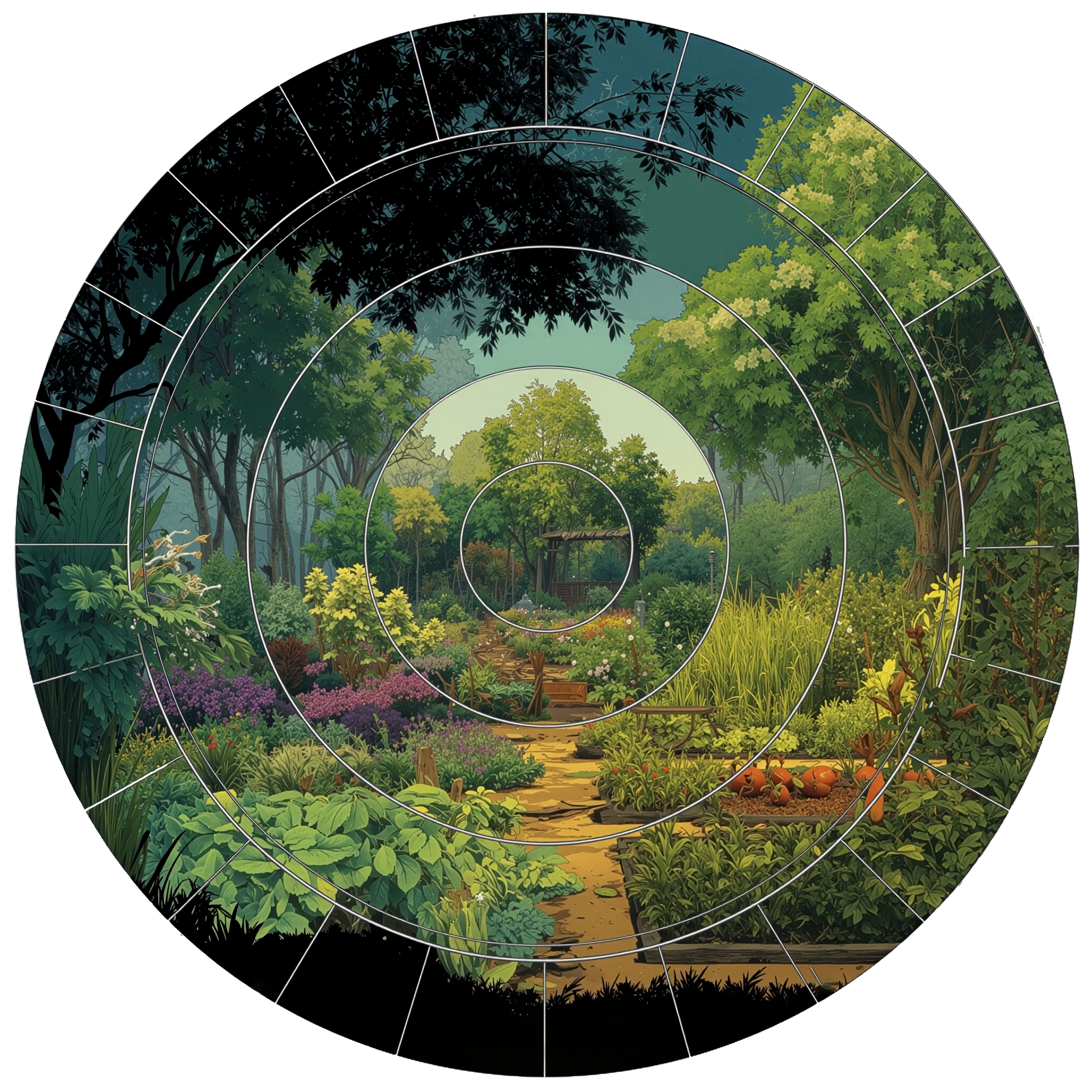
Permaculture offers a working map to begin organizing these systems of perception and action, its theory talks about zones: Zone 0 is the place visited most frequently: the home; Zone 1 the kitchen garden, Zone 2 larger garden, Zone 3 the tree orchard, Zone 4 the managed wild areas, and Zone 5 the un-touched land.
For us Nenqayni, Zone 0—the home—is nothing other than the body, the interior, because the first home we ever receive is the boundary of our own body. And if you travel enough, you will notice that around the world there are people with outwardly beautiful houses but with attitudes that are not of the same nature.
This is why Zone 0—the being—should be considered our primary work. Self-awareness and permaculture both seek to harmonize the environment in which their actions unfold, producing balance among the natural elements that compose each. In the case of permaculture, living species interact with the natural and structural environment; in the case of consciousness, observation, analysis, sensations, emotions, and actions interact with one another.
Just as the brain has the capacity to synchronize and relate stimuli and responses in certain regions to shape the personality through which we engage in any mental or social interaction, we too can collaborate with teachings, methodologies, and practices from the past or present. These allow us to integrate our own ways of self-evaluating our attitudes, actions, and patterns, so we can design systems of both low and high complexity—whether helping our community one day a week or initiating a project that benefits more than ten people.
All of this can unfold in our own time.
Which practices can you name that help shape the way we perceive, act, and relate to the world?
A. Valeria Mack